Thursday, September 2, 2010

My plan versus the bee plan


It seems the bees and I are not on the same page. I guess we're not reading the same books. Unbeknownst to me, my plan began unraveling when I reduced from 8 to 7 the number of frames in the 4th story of Galway.

By reducing the frames and spreading them equidistantly the bees were supposed to draw out the comb further in each frame to close the distance back to within 1/4 to 1/8 of an inch between frames. Bee space -- remember?

Well, I spread them and added a 5th story and when the bees drew most of that I reduced the frames in the 5th story and added a 6th story. It wasn't until a couple of weeks ago as I was readying for harvest that I went down in the hive and discovered the bees were operating with their own plans.

I had decided that I wanted to harvest the 4th story first -- it was the early summer honey that was produced from the millions of Bachelor Buttons in the meadow. From what I had read, Bachelor Button honey is a pinkish white honey and I really wanted to harvest some. So my plan was to bring the 4th story to the top of the hive and put the 6th story which had yet to be drawn into the 4th position -- a simple swap. That would make it easy to monitor the Bachelor Button honey and harvest it as soon as it was capped. Brilliant!

A couple of weeks ago I initiated the swap. When merely looking down into the 4th story from above everything looked good. The comb had been drawn out further just as my plan had called for. But when I removed the 4th story, there was brood comb and exposed brood all over the top bars of the 3rd story.

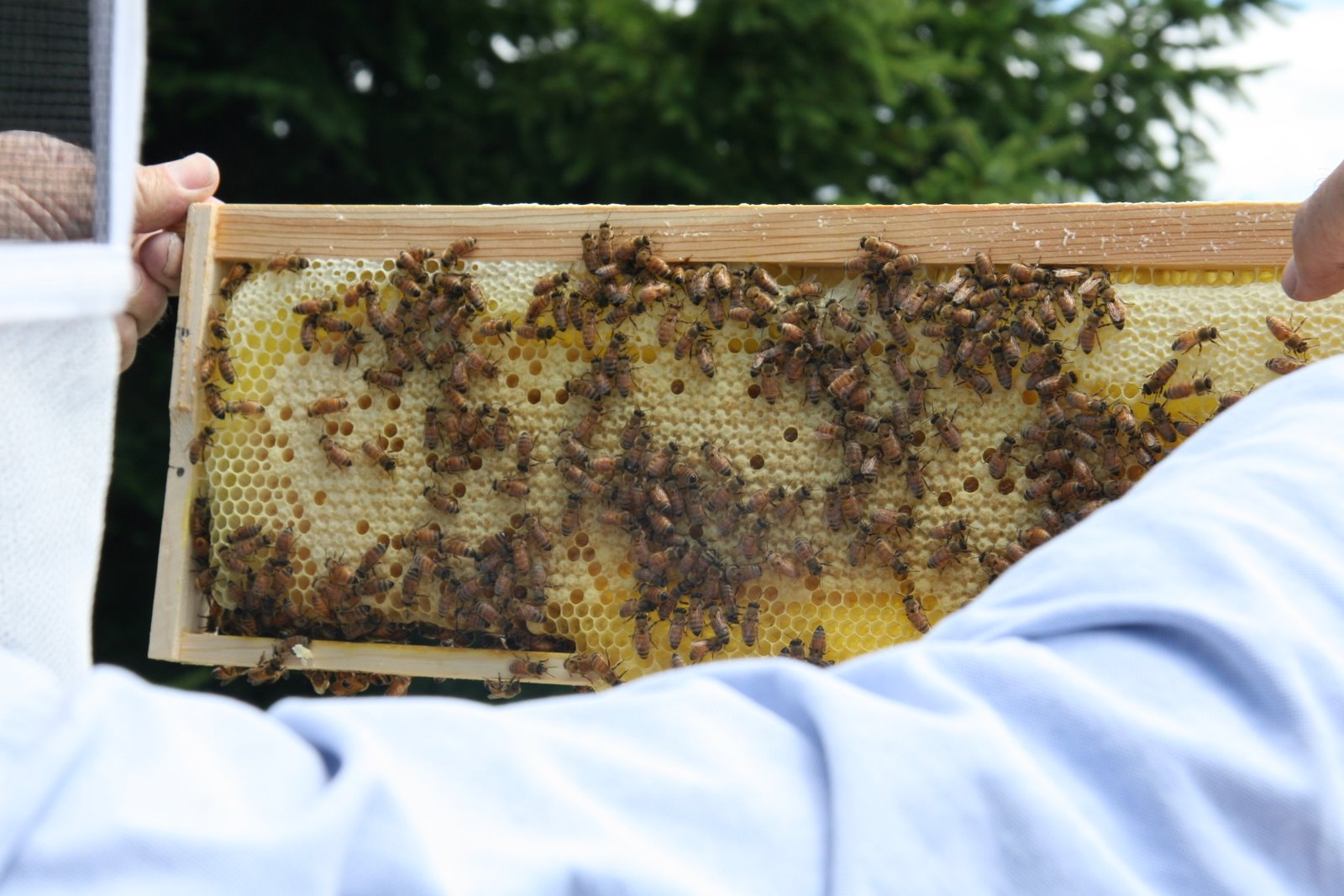
It seems the bees had drawn out the comb at the very top of the frames but they also built brood comb up in between the frames from the top bars of the 3rd story. Perhaps the 4th story frames were not hanging straight up and down in the hive body and there was more space in between the middle frames that allowed them to do this.

However they managed it, the lesson was not lost on me. I need to get down into the hive and examine individual frames and not just look down from above. I proceeded with my basic plan of swapping the 6th and 4th stories. And today I got back in the hive to see how things were going. Once again, the bees surprised me.

Much of the 6th story is full of capped honey but the center frames also have capped brood in the centers of each frame just as if they were down in the brood chamber. There must have been brood comb remaining in the 4th story when I moved it to the 6th story. So I'm giving up on my plan of harvesting supers full of honey and I will focus on harvesting frame by frame.

I may add a queen excluder between the 5th and 6th stories to let the brood hatch out and not have to worry about the queen continuing to use it for new brood.

Oh, and Clare. I decided a couple weeks ago to let Clare build its strength in preparation for winter. I put a feeder on it and have been feeding 1:1 syrup for the last few weeks. I'll change it to 2:1 in a few weeks. Its doing good but I've decided not to try and harvest anything from it this year.

Lastly, just in case you think I've been goofing off all of August, here's a sneak peek at the new website for selling honey that I may actually harvest someday: http://meadowlandshoney.com. If you look closely you'll also get a sneak peek at the label for that yet to be bottled honey.

Brian

Sunday, August 8, 2010

Getting ready for the harvest

Unless my hives are discovered by a wandering bear, I'm going to have some honey to harvest this year. Black bears have been seen in the neighborhood but the most recent sighting was a few years back and even then, it was at the edge of woods. To my knowledge there has never been a sighting in the open meadow.

I was encouraged to put up an electric fence around the apiary to keep bears out and I did so but after my dog was shocked (twice) I disconnected it. It's been a few weeks and the dog seems to have returned to normal and she seems to be staying clear of it so I may reconnect it. I've seen the damage bears can inflict on an apiary so I know the gamble I'm taking. I also know the guilt of seeing the dog reluctant to walk in her own backyard. She's not exactly sure where the boundary is so she won't come near that section of the yard.

Assuming I successfully wrestle the bear issue and I do indeed have honey to harvest, how do I get it away from the bees? I've been considering this issue lately.

Harvesting Methods

There are a number of methods to separate the bees from their honey ranging from simply shaking and/or brushing the bees off a frame at a time to using a leaf blower and blowing the bees out of an entire section of the hive body(also known as a honey super or simply a super). Some methods use odors to drive the bees out. Some methods called bee escapes use one way doors that let the bees go out but not back in.

Like most everything else in life, there are pros and cons to each method. The physical methods of removing the bees by shaking, brushing or blowing while immediately effective can and do annoy the bees and irritated bees are not pleasant to be around. Bee escapes take time -- typically a couple days and require at least 2 trips to the apiary. Also, if the bees are out of the honey too long without the beekeeper harvesting it other pests can move in. Using odors to drive the bees out -- well, this method stinks (and you can use too much and drive the bees out of sections you are not harvesting or too little and not drive them out at all.)

So what method do I plan to use? I'm going to try the bee escape method first. If that works effectively I'll stick with it but I'm also not opposed to the method that stinks if I can get the right product. "Fischer's Bee Quick" is said to be very safe and effective.

Bee Quick is used with something called a fume board. You spray a little on the fabric side of the board and then place the board above the super you want to clear. The fumes drive the bees down lower into the hive without harming the bees and leave no residual traces to adversely affect the honey being harvested.

Extracting the Honey

Once I've separated the bees from the honey, the next trick is separating the honey from the comb. Early on, I decided I wanted to extract the honey from the comb while leaving the comb intact rather than simply cutting the comb into sections and packaging it, or crushing the honeycomb and straining the honey from the crushed comb.

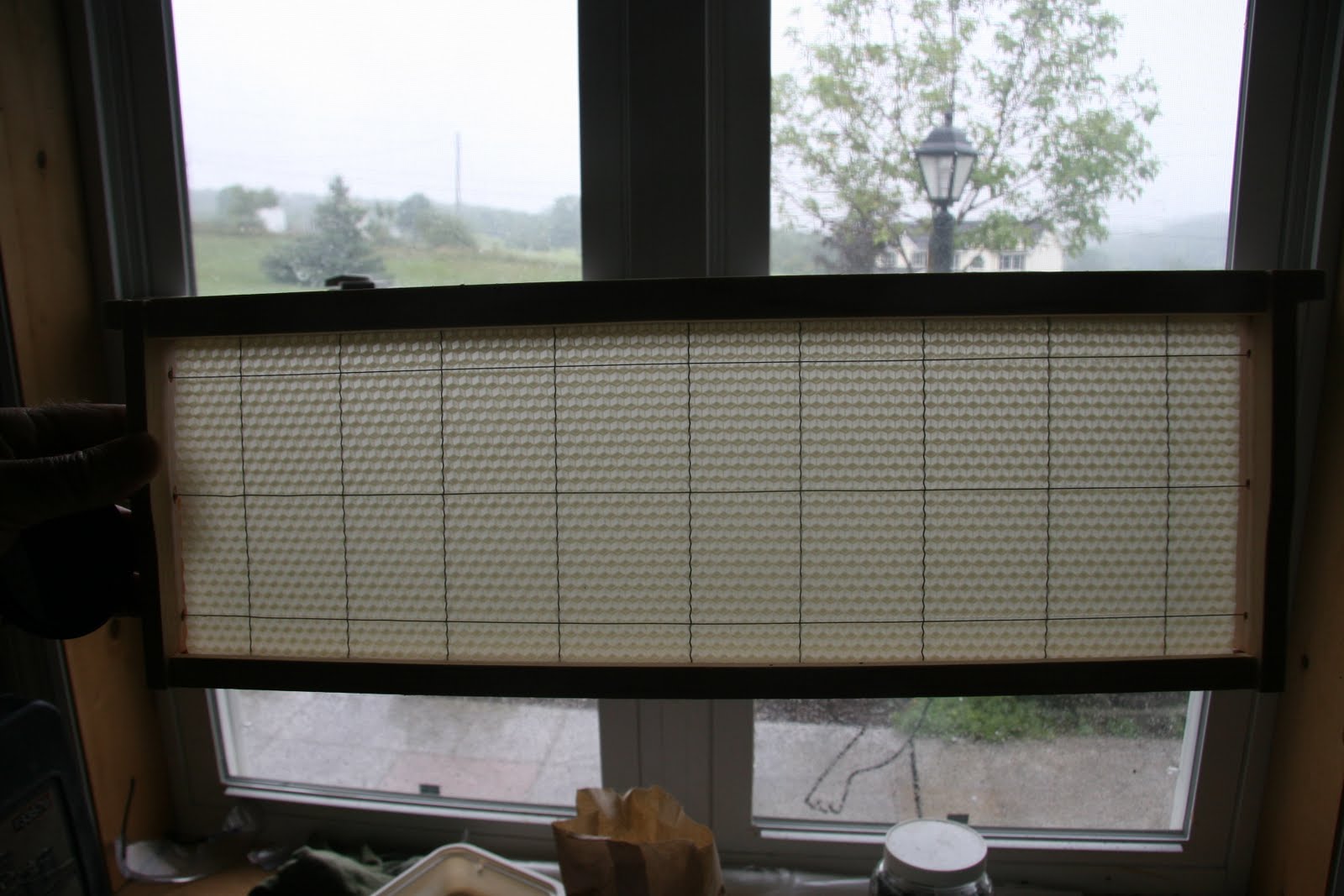
When I put together the frames in the hive, I reinforced the beeswax foundation with crisscrossing wires to help keep the honeycomb intact when subjected to the forces of the extraction equipment (see photo).

If I were going to package cut comb honey I would have used a very thin foundation (or no foundation at all) and I would not have used wires to reinforce the honeycomb. Likewise, with the crush and strain method of extracting honey, the wires would not be used. Neither of these methods requires a major investment in equipment to implement but the downside to them is that the bees have to start from scratch when working on the next honey crop because the honeycomb is forfeited in the processing.

It was because of that big downside that I decided I was going to extract the honey from the comb while leaving most of the comb intact. The comb can then be returned to the bees to clean up and refill. And because the bees don't have to expend as much energy and resources in creating honeycomb they are able to produce more honey in less time. The big downside to this method is the cost of the specialized equipment used to get the honey out of the comb -- the extractor.

An extractor is a type of centrifuge. The frames of honeycomb are placed in the extractor after the wax cappings covering the honey filled cells have been removed. There are special heated knives (and fork-like devices called capping scratchers) used for removing the wax caps, but regular bread knives and household forks have also been used.

When the extractor is loaded the frames are then spun, slowly at first because the frames are heavy with honey and even though the honeycomb is reinforced with wire at it's core it could still break apart under the stresses. As the honey is thrown out of the comb by centrifugal force to the walls of the extractor the frames become lighter and the speed can be increased. The honey flows down the sides of the extractor to the bottom where it flows through a valve called a honey gate, into a bucket fitted with 3 filters (coarse, medium and then fine) to filter out any bits of wax and the occasional honeybee.

The honey then rests in this bottling bucket for about a day or so to allow any air introduced during the extraction process to rise to the top of the bucket. This frothy topping is then skimmed prior to bottling the sparkling, pure, raw honey. The bottling bucket is fitted with a honey gate at the bottom to facilitate the bottling process.

After the extraction process, the frames are still wet with remnants of honey. These frames are returned to the hive where the bees readily clean them up. The wax cappings removed in the extraction process can be melted down and used in the creation of candles, lip balm and other products.

The extractor I decided upon will extract 6 frames at a time. It's the Ranger model from Dadant. I picked this particular model for a couple of reasons. Dadant has an excellent reputation for building a quality extractor. Dadant has a store less than an hour away. The extractor is big enough for my immediate needs and the used equipment market seems very good should the need arise to sell it and move to a larger extractor.

So now you know my plans. I may attempt my first harvest next weekend. I'm hoping the bees will have at least 1 super of capped honey ready by then. Keep your fingers crossed.

Oh, one more thing. The website and honey label are under construction. Hopefully they'll be ready for unveiling in the next couple of weeks.

Six high! My, oh my!


The girls keep working and the hives keep growing. In my optimism at the beginning of the season (and to minimize shipping costs) I planned for the best I could hope for in hive growth for first year colonies started from packages. I figured 6 stories would be the maximum. I may have underestimated. As of Saturday I have one hive body left in my supply.

Clare is doing great. The 3rd story is fully drawn and they've started work on the 4th. I decided to add a 5th just to make things roomy after Roger Hoffman, a beekeeper a couple miles down the road wrote me last week: "Major flow just starting up so if you don't have a couple empties on, get them on top ASAP." Must be the goldenrod. Rock and roll!

Galway had quite a bit of the 5th story drawn so adding the 6th seemed prudent even though I wasn't quite ready to reduce the number of frames in the 5th from 8 to 7. I need to wait until the frames are almost completely drawn before making that adjustment. Why? It helps the bees to develop the comb the way that I want instead of letting them get creative on there own.

As for the 4th story of Galway, the one that I did reduce from 8 to 7 frames, the bees have drawn it out completely and beautifully. That extra space between the frames has been filled with comb and that comb has been filled with nectar but it is not yet ready for harvesting. The bees are still drying it out.

When it became apparent that I would be harvesting some honey this year, I began searching in earnest for extracting and bottling equipment. And I've been toying around with label designs. Of course, when you design a label these days, you need to have your website listed -- so that got me thinking about creating a website for honey sales.

It just keeps going. And I keep going with the flow.

I've made my equipment choices and reserved my website. I've set up an account with Google for use with Google Checkout so I can offer honey for sale on line. I'll be doing the same with Paypal. The label is still a work in progress but it's coming.

In my next post, which I've started, I'll detail the equipment I selected and the reasons why. But I think at this point it's important for me to say that I don't really plan on getting into the honey business as a money making venture but I do want to thoroughly explore all the various facets of this fascinating new hobby.

Saturday, July 31, 2010

Transitions

I awoke this morning to temperatures in the 40's -- upper 40's yes, but still there was a hint of summer losing its grip.

Where once there were millions of bachelor buttons slowly unfurling in pinkish purple plumes, now the fresh blooms have dwindled and spent blooms bring a deepening brown shade to the meadow. So have most of the daisies given up their petals.

The black-eyed susans linger, their petals tinged in a tired white; the goldenrod is coming on strong and the Queen Anne's Lace is everywhere.

Summer has matured -- too soon for me but the bees are unfazed. I walked slowly through the meadow to see what they were up to. Bachelor Buttons were still the flower of choice. Good to the last drop, I guess.

I've never really paid so much attention to the plant life in the meadow. I have a lot to learn about what blooms when and what the bees like and what they don't. It seems they are no longer interested in the Queen Anne's Lace. Too bad -- we have plenty. I hear they really like goldenrod so we should be in good shape for the rest of the summer.

This morning I took a picture of a bee on a Bachelor Button -- nothing special and yet it seemed so special to me. The flower was tucked under the meadow canopy, hidden from everything but the honey bee and the dappled sunlight. It was in its final show of beauty as evidenced by its loosening petals. So too was the visiting bee an aging forager as evidenced by her tattered wings.

Two ordinary living things -- and a third -- unnoticed except by each other and the dappled sunlight -- a sacrifice to something sacred.

Tuesday, July 27, 2010

Thriving!

It's been a few weeks since my last post. I was out of commission for awhile but the bees haven't been.

On Saturday, I checked on Clare and the population was up, the 3rd story was close to fully drawn and things looked good. I added a 4th story and pulled the feeder.

In Galway things were that much better. The 4th story was fully drawn and loaded with uncapped honey.

I pulled one of the frames and used some homemade frame spacers to evenly space the remaining seven frames in the 8 frame hive body. Why? Nothing is ever simple but the reason in a nutshell is that it makes it easier to harvest the honey. It has to do with leveraging something called "bee space." Here's how it works.

Bee space is the space between comb and parts of the bee hive that allow a bee to pass through. It measures 1/4" to 3/8". If anything in the hive violates bee space, the bees will fill it with comb if it exceeds the 3/8 inch or glue it shut with propolis if it is less than 1/4 inch. Propolis is a resinous mixture that honey bees collect from tree buds, sap flows, or other botanical sources.

So by giving a little extra space beyond the standard 3/8-inch spacing between the frames, the bees will draw out the existing comb further and fill it with more honey, thus closing the space between frames back to within bee space. When they cap the honeycomb, the caps will protrude beyond the wooden edges of the frame. This will make it easier to remove the caps with a capping knife when it comes time to harvest the honey.

After rearranging the 7 frames of the 4th story, I took the frame I pulled and used it as one of the frames of the 5th story. This will encourage the bees to move up and begin drawing the comb in the new addition.

We finally got some rain over the last week. That should keep things blooming. The lack of rain in the weeks prior had kept me from having to mow the lawn. Maureen would take issue with that -- she's been "encouraging" me to mow. I look at the lawn full of clover and these little yellow flowers that the bees love and I am conflicted. It gets crazy, doesn't it? So now I mow at night when the bees aren't foraging. And I mow as infrequently as possible. And people keep commenting on how nice the lawn looks. Seems like I've struck a balance. I think Maureen would agree albeit reluctantly.


One last thing before I close regarding Queen Anne's Lace. We've all seen that beautiful weed blooming all over the roadsides and meadows. I wondered if the bees liked it so I went looking yesterday and found that they do. I brought up the topic with a fellow beekeeper and she asked if I was sure the bees were working the flowers or just curious about them. It seemed to me they were working them but I did some web research to see what I could find.

I was surprised to learn that Queen Anne's Lace is also known as wild carrot and that its taproot is indeed an edible carrot. My grandmother probably knew it but I never did. Oh, and yes, the bees like its nectar.

Wednesday, July 7, 2010

So Why Bees?

The question I get asked most often about my new hobby is "Why?" Sometimes, they ask it as a two part question: "Are you crazy? Why would you ever get bees?" Then there's the approach that implies the question and suggests an answer: "Well, that's one good way to get out of hosting family parties!"

Well, we're still hosting plenty of family parties and the hives have become part of the attraction, creating a serene view from the back patio into the meadow. So that's not the answer.

When my daughter Kara heard the question posed she responded quickly and confidently "I know why!!" I couldn't wait to hear the answer.

"You watch out for my glasses and I'll watch out for your bees."

I knew immediately what she was referring to and smiled to think of it. Years ago I was out on the tractor mowing the yard. I had a new pair of prescription glasses in my shirt pocket. At some point the glasses bounced out and were somewhere in the 5.25 acres of yard. I figured I'd look out for the glasses as I continued to mow.

As I mowed and closely examined the yard I became very much aware of all the bees on the wildflowers that I was mowing down. I slowed the tractor and tried to let the bees get out of the way. And then I made the deal: "You watch out for my glasses and I'll watch out for your bees."

For the rest of the 4 hour job I focused on not mowing down any bees. It made the job longer but much more interesting. At the end of the job, I hit a bump that knocked something loose. I stopped the tractor and there on the ground were my glasses. The frames were a bit twisted but I straightened them and wore them for years. And to this day I brake for bees.

Over our 10 years here in the Meadowlands we have slowly allowed more and more yard to revert back to meadow. We've spread wildflower seed to help things along. And over those years, we've become more in tune with the life in the meadow: the bluebirds and tree swallows, goldfinch and robins, the red winged blackbirds and black capped chickadees; the hawks and the meadow mice, rabbits and woodchucks and the occasional visitors like fox and pheasant. I'd like to see more of them.

So why any of that?

It seems it comes down to an awareness of loss; an awareness of my own mortality and a need in me to embrace that mortality and to engage life; to rediscover the wonder I knew as a child.

It's funny. When I plant a tree now I wonder who will be enjoying its shade. It's not morbid -- it's simply true. I don't dwell on it nor does it discourage me from planting trees. On the contrary, I smile to think of it and probably plant more trees because of it.

I'm putting the brakes on this explanation. I'd end up writing a book. Suffice it to say that life has tenderized me -- worn me down and built me up again into something different. The new me likes feeling at one with his surroundings. Being a beekeeper makes sense to that new more tender me.

A tender -- there's a gentleness to it that I like. I am not so much a beekeeper as a bee tender. And come to think of it, that isn't a bad way to live. Bee tender.

Feel the hug.

Friday, July 2, 2010

Added My First Honey Super

Things were looking good in both the colonies today. Clare was showing strong signs of making a comeback and Galway was busting at the seams.

I may still need to give Clare some help but things are going well enough that I am comfortable giving it a few weeks longer before making that determination.

The new feeding method is working beautifully. There have been no drownings. It's easy to service and refill the feeders without smoking the hives and there is better ventilation in the hives because the upper entrance isn't blocked.

I added a third hive body to Clare today. The second story still wasn't quite as full as it should have been but things seem so busy now I wanted to make sure they had the room when they needed it. I did see capped brood, eggs and larvae in Clare and there seemed to be more bees in a more active state than in my last visit to the hive.

In Galway, all 8 frames of the third story were almost fully drawn. As I inspected the frames I was surprised and delighted by the weight of each one. They were laden with honey and it was much more difficult to separate the frames than when everything was new and clean just a couple of weeks before. There was a sticky, thick abundance to the hive that shouted "Life is good!"

I added a fourth story to Galway and pulled the feeder. The colony is strong enough and there is enough of a flow on for the bees to draw the frames of the fourth story without supplemental feeding. And the honey they store in these frames I can harvest!

I hope everyone has a wonderful holiday weekend. Mine is off to a great start!